The Complete Baby Nutrition Guide (0–24 Months)
Evidence-based feeding from birth through toddler years — what to feed, when to start, what to skip, and the one rule that prevents 80% of feeding battles.
What's in this guide
- Birth to 6 months: milk is the meal
- Starting solids: the 6-month gate
- Months 6–9: textures and the first foods
- Months 9–12: the explorer phase
- 12–24 months: family table integration
- The 9 priority allergens and how to introduce them
- Iron, the deficiency hiding in plain sight
- Red flags every feeding parent should know
- The Division of Responsibility — the rule that ends mealtime fights
- Tracking what matters (and what doesn't)
Birth to 6 months: milk is the meal
For the first six months of life, breast milk or iron-fortified infant formula provides everything a healthy term baby needs. The American Academy of Pediatrics, the World Health Organization, and the Academy of Nutrition and Dietetics all agree on this — and they don't agree on many things.
This single fact contains three implications that every new parent should internalize. First, you do not need to introduce water, juice, cow's milk, honey, or any solid food before six months under typical circumstances. Second, "exclusive milk feeding" includes baby vitamins your pediatrician may prescribe (most commonly vitamin D 400 IU daily for breastfed infants). Third, the question is not whether to feed milk, but how much, and on what cadence.
Breastfeeding: what's normal vs what's a problem
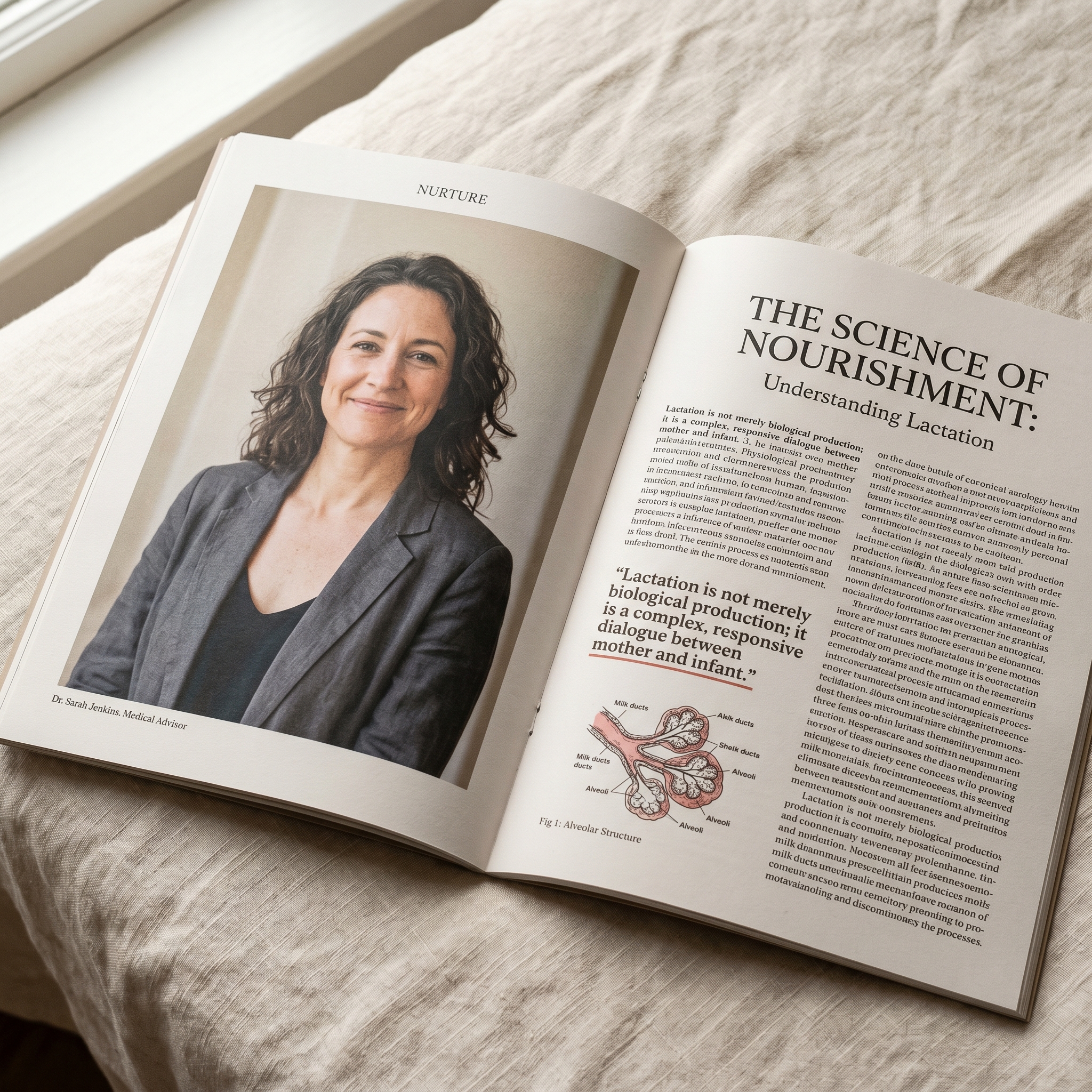
Breastfeeding is biologically supply-and-demand. The more your baby nurses, the more milk you make. This is why "feeding on cue" — responding to early hunger signals like rooting, hand-to-mouth, and lip-smacking before crying starts — protects your supply better than rigid schedules in the first six weeks.
The signs that breastfeeding is going well are simpler than most new parents realize: at least 6 wet diapers per day after day 5, at least 3 stools per day in the first month, audible swallowing during feeds, and a baby who appears content for at least some portion between feeds. Weight gain of 5–7 ounces per week in months 1–3 is typical. Growth charts plotted against WHO standards (not CDC) provide the most accurate picture for breastfed infants — most pediatricians now default to WHO charts for under-2.
The signs that something needs attention: fewer than 6 wet diapers per day after day 5, no stool for more than a day in month one, weight loss exceeding 10% of birth weight, sustained back-arching or refusal at the breast, persistent painful latch, or a baby who never seems satisfied. Any of these warrants a lactation consultant or pediatrician visit within 24–48 hours.
Formula feeding: the rules that matter
The choice between breast and formula is one of the most over-debated and under-explained decisions in modern parenting. Here is what the evidence actually supports: a fed baby thrives. Standard cow's-milk-based iron-fortified infant formula meets all nutritional needs for the first 12 months. Hypoallergenic, hydrolyzed, and specialty formulas have specific medical indications and should be used only on pediatrician recommendation.
Preparation matters more than brand. Use safe water (most US tap water is fine; well water should be tested and possibly boiled), follow the scoop-to-water ratio exactly (over-concentrated formula stresses kidneys; over-diluted causes water intoxication), and use within one hour of preparation if at room temperature, two hours if refrigerated. Never reuse a partially consumed bottle from a previous feeding — bacteria from baby's mouth multiplies rapidly in formula.
By month 4, most formula-fed babies settle into a pattern of 6–8 bottles per day totaling 24–32 ounces. The single most common feeding mistake in formula-fed infants is over-feeding driven by parental anxiety. A bottle is finished when the baby turns away, slows dramatically, or falls asleep. Forcing the last ounce or two — what pediatricians call "completion feeding" — predicts weight gain above the 95th percentile and may contribute to feeding aversion later.
Starting solids: the 6-month gate
Six months is the gate, not the starting line. Four-to-six months was the old American guidance, but a meta-analysis published in Pediatrics in 2019 and reaffirmed by AAP in 2022 supports waiting until close to six months for most infants. The reason isn't food itself — it's developmental readiness.
- Can sit upright with minimal support for at least one minute
- Has lost the tongue-thrust reflex (food doesn't automatically push out)
- Shows active interest in food (reaches, opens mouth, watches you eat)
- Can move food from front to back of mouth and swallow
Starting before readiness predicts feeding refusals, choking incidents, and increased risk of overweight in childhood. Starting after 7 months without medical reason predicts iron deficiency and may increase allergy risk according to the LEAP and EAT trials.
The first week of solids
Start with a single food at lunchtime, when baby is mildly hungry but not ravenous, and you have time to observe for two hours after. Iron-rich single-grain infant cereals, pureed meat, or pureed beans are all evidence-supported first foods — the iron content matters more than which one. Avoid starting with sweet purees (banana, apple, sweet potato) only because they're easy, because babies who learn that "first food = sweet" can become harder to transition to bitter greens and proteins.
Offer 1–2 teaspoons. Don't worry about how much goes in — most of the first week is for tasting, not nutrition. The breast milk or formula remains the main meal. Repeat the same food for 2–3 days to watch for reactions, then introduce a new one. The "wait 3 days between new foods" rule is being relaxed by some pediatricians (the LEAP trial shifted thinking), but for the first 3–4 weeks of solids it's still useful for spotting any sensitivity.
Months 6–9: textures and the first foods
Between 6 and 9 months, a typical eating pattern develops: 3 milk feeds plus 1–2 small solid meals, then 3 milk feeds plus 2–3 solid meals by 9 months. The proportion of nutrition coming from solids gradually rises from about 10% at month 6 to 25–30% by month 9.
This window is when texture progression matters. Purees alone for too long delays the development of oral motor coordination needed for chunkier textures, and predicts texture aversion later. By month 7, move from smooth purees to mashed-with-lumps; by month 8, soft chunks the size of a pea; by month 9, soft finger foods baby can self-feed.
This is also where Baby-Led Weaning (BLW) and traditional spoon-feeding diverge philosophically. Both work. BLW skips purees entirely and offers soft finger foods from the start; spoon-feeding follows the puree-to-chunks progression. The BLISS trial published in 2017 found no significant difference in growth, choking risk, or iron status between the two approaches when both are done correctly. The factor that matters more than method: parental responsiveness and pace.
What to offer (and what to skip)
| Always OK after 6 months | Limit or avoid |
|---|---|
| Iron-fortified infant cereals | Cow's milk as a drink (under 12 months) |
| Pureed meat, fish, chicken | Honey (under 12 months — botulism risk) |
| Eggs (whole egg, fully cooked) | Added salt and sugar |
| Yogurt, cheese (full-fat) | Choking hazards: whole grapes, nuts, popcorn, hard candy, hot dog rounds |
| Mashed beans, lentils, tofu | Juice (limit to 4 oz/day after 12 months only) |
| Soft cooked vegetables | Smoked, cured, or high-mercury fish |
| Soft fruits (banana, avocado, peach) | Unpasteurized dairy |
| Iron-rich grains (oats, fortified cereal) | Caffeinated drinks (always) |
Months 9–12: the explorer phase
By month 9, most babies are working three meals a day plus 1–2 snacks, with milk feeds dropping to 4–5 per day totaling 20–24 ounces. The texture progression accelerates: lumps become small chunks become bite-sized pieces become finger foods baby self-feeds with pincer grasp.
Self-feeding is the headline skill of this stage. Even if you spoon-feed primarily, give baby a spoon to hold, soft finger foods to grab, and the dignity of making a mess. Babies who feed themselves from 9 months on have measurably better eating regulation by age 2 — meaning fewer picky-eating battles, better satiety signals, and a healthier relationship with hunger.
Three things that happen in month 10–12 surprise most parents. First, food intake often drops as growth velocity slows. The growth spurt of months 0–6 was unsustainable; the slowdown is biology, not a feeding strike. Second, preferences emerge — the broccoli your baby loved at month 7 may get pushed off the tray at month 11. This is normal flavor exploration, not a refusal of vegetables forever. Third, drinking from an open cup (with help) becomes possible. Sippy cups bypass important oral motor development; start open-cup practice at 9–10 months with a tiny amount of water at meals.
12–24 months: family table integration
One year is the gate where cow's milk becomes appropriate as a drink — typically 16–24 ounces per day of whole milk (full-fat) for toddlers under age 2. The fat in whole milk is needed for brain development; the switch to low-fat is typically deferred until 24 months, and only earlier if your pediatrician identifies a weight concern.
The bigger shift at 12 months is conceptual: your toddler stops being a baby with separate meals and starts becoming a family table member. The same lunch you eat — with appropriate portion size and minus the choking hazards — is what baby eats. This is logistically simpler for parents, nutritionally richer for toddlers, and developmentally important. Toddlers learn what food is by watching what the family eats. Variety in your meals = variety in their palate.
The picky-eating window
Between 18 and 30 months, most toddlers go through neophobia — the active rejection of new or previously accepted foods. This is evolutionary biology, not behavior. A mobile toddler who would put anything in their mouth would not survive in the ancestral environment; the brain installs a "be cautious of new food" filter exactly when locomotion arrives.
The research is clear that two strategies work and two strategies fail. The strategies that work: continued exposure (it takes an average of 8–15 exposures to a new food before acceptance) and parental modeling (eat it yourself, visibly, often, without comment about whether your toddler is eating it). The strategies that fail: pressuring ("just one bite"), bribing ("if you eat broccoli you get dessert"), and short-order cooking (making a separate meal because the planned one was rejected).
Three observations about picky eating that contradict popular advice. First, picky eating peaks at 24 months and declines steadily through age 5 — it's not a permanent personality trait. Second, the "5-a-day" of fruits and vegetables is far less important than parents fear; most toddlers get adequate vitamins from 1–2 servings per day plus the rest of their diet. Third, toddlers who skip a meal almost always make up the calories at the next one. The week's intake matters more than any single meal.
The 9 priority allergens and how to introduce them
The most important shift in pediatric nutrition over the past decade is the reversal of allergen advice. The old advice — delay peanuts, eggs, and fish past age 1, 2, or even 3 — actively caused allergies in children at risk. The LEAP trial published in 2015, followed by the EAT trial in 2016, demonstrated that early introduction of these foods reduces allergy by 70–80% in high-risk infants.
Current AAP guidance (2021) recommends introducing all major allergens between 4 and 6 months unless your baby has severe eczema or known egg allergy (in which case talk to your allergist first). The nine priority allergens, in order of how frequently they cause clinically meaningful reactions:
- Milk (most common in infancy, usually outgrown)
- Eggs (often outgrown by age 5)
- Peanuts (rarely outgrown, but reduced 81% by early introduction per LEAP)
- Tree nuts (often persistent)
- Wheat (frequently outgrown)
- Soy (frequently outgrown)
- Fish (often persistent)
- Shellfish (often persistent)
- Sesame (added to US labeling 2023; rising in prevalence)
Signs of a true allergic reaction within two hours: hives, swelling around eyes or lips, vomiting, wheezing, difficulty breathing. Mild rash around the mouth from food residue is irritation, not allergy. True allergy warrants immediate medical attention; severe reactions require 911. Once introduced successfully, an allergen should be consumed at least 2–3 times per week to maintain tolerance.
Iron, the deficiency hiding in plain sight
Iron deficiency anemia is the most common nutritional deficiency in US infants and toddlers, affecting an estimated 8–14% of children aged 12–24 months. It's especially silent — by the time it causes obvious symptoms (pale skin, fatigue, slow growth), it has often already affected neurodevelopment. The window of vulnerability is months 6–24, when brain growth is most rapid and iron needs are highest.
Term breastfed babies have enough stored iron from gestation to last until about 6 months. After that, iron must come from food. Formula-fed babies get iron from iron-fortified formula, but the bioavailability is lower than breast milk iron (which is well-absorbed) or heme iron from meat (the best-absorbed source). Cow's milk introduced too early (before 12 months) or in excess after (more than 24 oz/day) blocks iron absorption and is the leading cause of iron deficiency in toddlers.
The protective foods, in order of iron content per typical serving for babies and toddlers: red meat (the gold standard, even small amounts), chicken liver (controversial but extremely high), beans and lentils (with vitamin C food for absorption), iron-fortified infant cereals, eggs, dark green leafy vegetables. Aim for one iron-rich food at each main meal from month 6 onward.
The AAP recommends a hemoglobin screening at the 12-month well visit. If you're concerned earlier — pale appearance, low appetite, slow growth, or excessive milk intake — request the test sooner. Treatment is simple if caught early; the neurodevelopmental consequences if missed can be lasting.
Red flags every feeding parent should know
Most feeding concerns parents bring to pediatricians are normal variation. A few are not. The signs that warrant earlier-than-routine medical evaluation:
- Persistent feeding refusal — not a single meal skip, but multiple days of refusing food in a previously accepting baby. May indicate illness, oral aversion, or reflux.
- Failure to gain weight or weight loss after the typical newborn drop-and-recover pattern. Crossing more than 2 percentile lines downward warrants evaluation.
- Persistent vomiting (not spit-up) — forceful, projectile, or repeated within an hour of feeds.
- Blood in stool — possible cow's milk protein allergy, anal fissure, or other GI issue. Worth a call same-day.
- Suspected allergy reaction — hives, swelling, wheezing within 2 hours of a food. Stop the food and contact pediatrician (mild) or 911 (severe).
- Difficulty swallowing — choking on age-appropriate textures, persistent coughing during feeds, food coming out of nose.
- Significant texture aversion at any age, especially in toddlers who refuse entire categories (all wet foods, all chewy foods) and lose weight as a result.
- Pica — eating non-food substances regularly (dirt, paper, hair) beyond casual mouthing. May indicate iron deficiency.
The Division of Responsibility — the rule that ends mealtime fights
If there is one feeding principle every parent should know, it is Ellyn Satter's Division of Responsibility, developed by a feeding therapist over four decades of clinical work and now adopted by AAP and the Academy of Nutrition and Dietetics as the gold standard for childhood feeding.
The rule is simple. Parents are responsible for what is offered, when it is offered, and where meals happen. Children are responsible for whether they eat, and how much. That's it. The boundary is total and bidirectional: parents don't decide how much; children don't decide what's served.
Three practical implications. First, serve the family meal — including foods you know your child likes and foods they may not — at predictable times in a predictable place. Second, do not negotiate, bribe, threaten, or comment on how much or what your child eats. Third, if your child eats nothing, the next opportunity to eat is the next scheduled meal or snack (not a special meal made on demand, not endless snacking between).
This sounds harsh and feels harsh to parents in the moment. The research evidence supporting it is overwhelming. Families who adopt Division of Responsibility report dramatically fewer mealtime battles within 2–4 weeks, and their children show better long-term outcomes for self-regulation, BMI, and food variety.
Tracking what matters (and what doesn't)
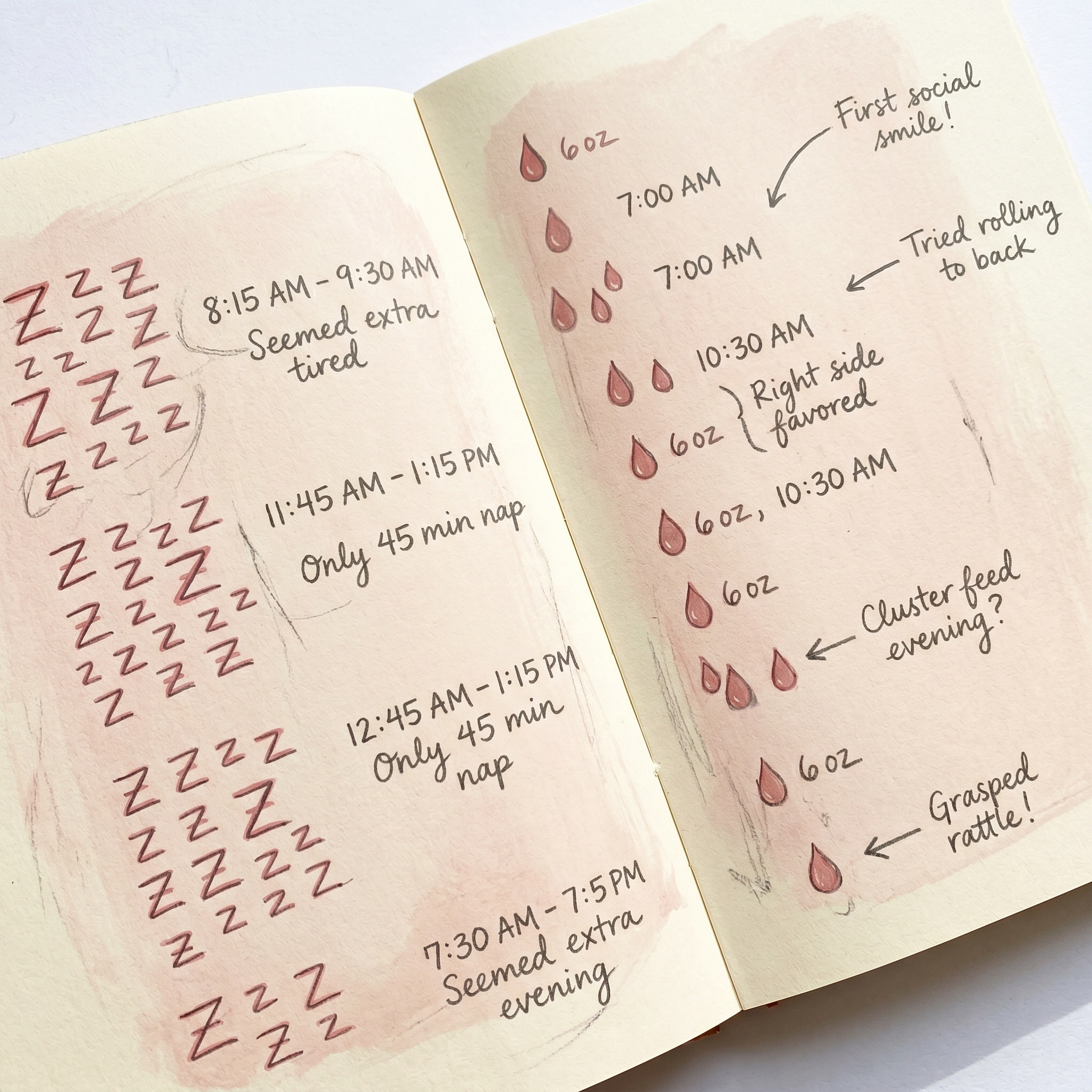
The most useful thing to track in baby feeding is not what most apps default to tracking. Volume of breast milk per session, ounces per bottle, and detailed solids logs are surprisingly low-value for healthy babies — they create anxiety without adding clinical insight.
What actually matters and is worth tracking:
- Wet diapers per day — the single most reliable indicator of adequate intake in 0–6 months. Aim for 6+ per day after the first week.
- Weight gain trajectory on WHO charts — not absolute weight, but trajectory. Crossing percentile lines either direction warrants attention; staying on a curve is reassurance regardless of which curve.
- Food categories introduced — by 9 months, has baby tried: red meat, eggs, peanut, fish, dairy, beans, leafy greens? Not how many times, just yes/no for the major categories.
- Iron-rich foods per day from month 6 onward. Aim for at least one per main meal.
- Feeding atmosphere — are meals calm and pleasant, or stressed? The emotional pattern predicts long-term eating relationship more than any specific food.
The Wermom App makes this tracking effortless
Wet diaper counts, weight curves on WHO standards, food category coverage, iron tracking, and feeding patterns — all in one place, all visual, all actually useful to your pediatrician at well visits.
10-day free trial. Cancel anytime. No data sold, no ads.
Try Wermom App freeFinal thought
Baby feeding looks complicated because there are 24 months of changes, three feeding methods, nine major allergens, and a flood of conflicting advice. The underlying truth is simpler. Healthy term babies, given milk on cue for six months, then iron-rich solids at the right developmental moment, then a varied family table with calm structure, will thrive. The job is not to perfect every meal. The job is to provide consistent opportunity, eat alongside them, and trust the system biology designed.
You will mess up. Every parent does. The baby in the high chair is more resilient than the parent worrying about the menu, and the toddler refusing dinner has not made a permanent decision about broccoli. Show up the next meal calmly. The compound effect of a thousand calm meals matters more than any single one.
References and further reading
- American Academy of Pediatrics, Committee on Nutrition. "Feeding Practices and Nutrition in Infancy and Childhood." Pediatrics, 2022.
- World Health Organization. "Infant and Young Child Feeding." 2023 guidance document.
- Du Toit G, et al. "Randomized Trial of Peanut Consumption in Infants at Risk for Peanut Allergy." New England Journal of Medicine, 2015. (The LEAP trial.)
- Perkin MR, et al. "Randomized Trial of Introduction of Allergenic Foods in Breast-Fed Infants." New England Journal of Medicine, 2016. (The EAT trial.)
- Daniels L, et al. "Baby-Led Introduction to SolidS (BLISS) study." BMC Pediatrics, 2015 (protocol) and 2017 (results).
- Satter E. "How to Get Your Kid to Eat: But Not Too Much." Bull Publishing.
- Centers for Disease Control and Prevention. "Iron Deficiency Anemia Screening Guidelines for Infants." Updated 2021.
- Academy of Nutrition and Dietetics. "Position of the Academy of Nutrition and Dietetics: Promoting and Supporting Breastfeeding." Journal of the Academy of Nutrition and Dietetics, 2015.